20/02/2026
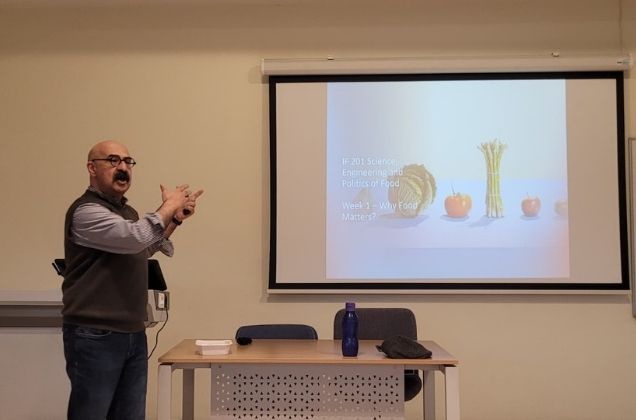
The IF 201 – Science, Engineering and Politics of Food course, launched this semester at Sabancı University, offered a broad discussion platform in its first session, addressing food not only as a nutritional issue but also in its historical, social, and political dimensions.
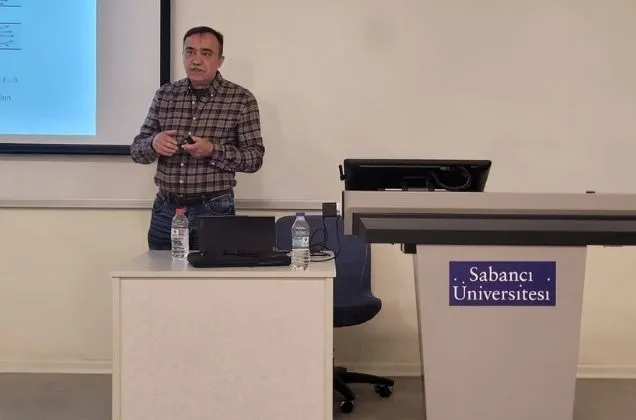
The opening presentation in the first week of the course, coordinated by Prof. Dr. Zafer Yenal, was also given by Yenal himself. From the first week, the course invited students to question the complex processes, scientific and political dynamics behind "the food on your plate."

From Breakfast to Global Networks
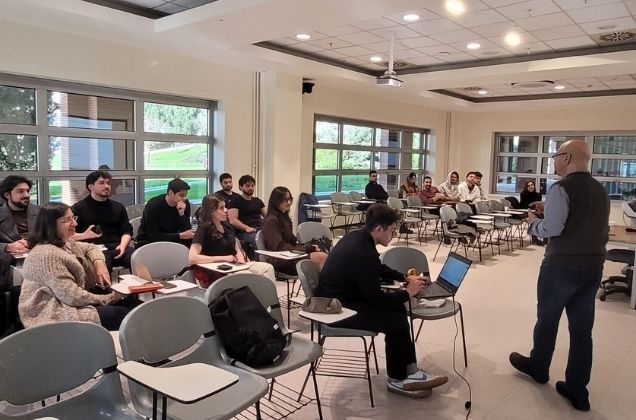
The first session began with the question, "What did you eat this morning?" The students' answers quickly turned into a discussion extending to the global circulation of food, its production, and trade networks. The geographical origin of food and its place in international trade were discussed using the example of tuna; the global dimension was mentioned with examples such as the Tsukiji Fish Market in Japan.
It was emphasized that breakfast habits vary according to region and socio-economic conditions. It was stated that food preferences are closely related to income level and reflect class differences.
History, Politics, and Food
The course explained how many foods that are considered commonplace today became widespread over time. It was noted that eggs and meat became more accessible with industrialization after the 1950s, while tea reached mass consumption in Türkiye thanks to state incentives. Thus, it was emphasized that food is not only a product of natural conditions but also of political and economic decisions.
Identity, Power, and Inequality
The course addressed the connection between food and identity, memory, and power relations. It was stated that food can sometimes be unifying and sometimes divisive; and that it is intertwined with class, gender, and ethnic differences.
The spread of food cultures with migration, which sometimes creates tensions over origin and location, was discussed with examples. It was noted that the concept of luxury has changed historically; and that today, "organic" and "local" products have become new prestige indicators.
Conservation, Innovation, and Application
The course framework addresses vital issues such as biodiversity, water management, and the conservation of local seeds, not only focusing on preserving the past but also developing innovative solutions to current environmental and social challenges. The opening session highlighted how the concepts of “conservation” and “innovation” reinforce each other for the sustainability of food systems; the importance of proactive strategies to respond to the needs of a changing world was emphasized.
The applied aspect of IF 201 was also highlighted. It was stated that students could work with the Culinary Arts Academy for their projects, plan practical processes with chefs, and be offered laboratory alternatives. It was particularly emphasized that the course offers not only a theoretical but also an experiential learning process.
With this first session, IF 201 has made a start aiming to develop a holistic look at food from the perspectives of science, engineering, and politics. The next session will feature Assoc. Prof. Ogün Adebali from the Faculty of Engineering and Natural Sciences at Sabancı University. With Adebali's contribution, a new framework will be offered for food systems from the perspectives of evolution, biodiversity, and scientific research. Throughout the semester, the course will continue to consider the scientific, historical, and social layers behind food together.